NEW YEAR’S EVE IN PUERTO MAYA
Towards the beginning of December 1978, Jacques Lizot, a French anthropologist and student
of Levi-Strauss who had been living for 15 years with a tribe of Yanomamo Indians on a strip of
land in the Amazon jungle where Venezuela, Colombia and Brazil touch, knocked on my door
at six in the afternoon. I found him on the threshold, tall, thin with his usual long beard,
disheveled and with deep eye sockets that looked like he hadn’t slept for a few days. He was
wearing a checked shirt, light-colored pants stained with mud and old sandals that had been
repaired countless times over the years. Lizot had been introduced to me by a mutual friend, a
Spanish anthropologist who had married a Venezuelan woman and was living in Caracas.
Unable to accommodate him because of space, he himself had asked me to lend Lizot a room
in the house where I was living when, for bureaucratic reasons, he had to leave the jungle of
the Rio Negro and come for a few days to the civilization of Caracas. The bureaucracy was
necessary for the creation of a large Natural Park, in collaboration with Brazil, to be reserved
for the Yanomamo Indians . The project had just begun and the paperwork and permits were
slow to obtain. (Finally the Yanomamo Park was created in the 90s but there are still many
problems today of invasion of the territory by the “garimpeiros” unscrupulous gold miners.) To
come to Caracas from the Shabono, the large communal house where he lived with the tribe,
Lizot first had to cross the jungle on foot to a river, take a canoe and reach the great Rio Negro,
a tributary of the Amazon. From there, sailing for several hours against the current with a
motorized “lancha” of the Venezuelan army, he arrived at San Carlos de Rio Negro where he
had to take an “avioneta”, a small Chessna plane, to Puerto Ayacucho and from there finally a
regular flight to Caracas. But his face was tired for another reason. When he arrived at the
military post on the Rio Negro to take the motorized boat, the military had run out of gasoline
and he had to wait three days for supplies to arrive. Colombia is on the opposite bank of the
river and the Venezuelan military regularly resold the government’s gasoline to the
Colombians, to buy Agua Ardiente, always running out of gas until the next supply arrived.
Lizot arrived unannounced and this was his third visit but there was something different from
his previous visits: this time he was accompanied by two young Yanomamo Indians who
looked at me curiously with their almond-shaped eyes barely visible under the horizontal bangs
that ended at the edge of the eyebrows. In their ears, like earrings, they had yellow and green
parrot feathers. One of them, perhaps the oldest, had his face pierced by perfectly smooth
wooden needles. A needle entered one side of the mouth and exited the other and three other
needles were symmetrically stuck into his chin. On their feet they had old rubber flip-flops.
As soon as they entered, the two Yanomamo went straight into the garden where there were
some hammocks, they sat down and abandoned themselves to the lazy swinging, chatting in
very low voices. Lizot went to take a shower and I prepared something to eat. “What will the
Indians eat?”

Jaques Lizot
Dinner consisted of an omelette, rice, salad with tomatoes and the casabe they had brought,
which is a round, crunchy bread, flat like a disk and white as milk, made with flour from the root
of Yuca, a plant that grows in the jungle and is the basic food of the Yanomamo. Lizot and I sat
at the table and the Yanomamo took their plates and went to eat with their hands sitting on the
hammocks with a familiarity of gesture that seemed to be at home. “In fact, I thought, they
invented the hammock…” Lizot had an ambitious project in mind. Considering that sooner or
later the Amazon Indians will have to come into direct and not sporadic contact with the
whites, the formation of a Yanomamo Park was not enough and it was necessary for the
Yanomamo to know who the white man is, what “civilization” is, it was important that they were
prepared for the cultural shock that would follow. To do this he had brought with him the two
young Indians who, for the first time in their lives, were leaving the green of the forest, they had
taken two planes and found themselves in the reinforced concrete of the international airport of
Maiquetia with that beautiful hallucinating optical floor of Cruz-Diez and they had taken a taxi
to get to my house in Caracas. On the way back they would tell their experiences and talk
about us and our world.
My little garden would be their home during the following days, it was the one that most
resembled the jungle. There were trees, a bit of greenery, Trinitaria flowers of different colors,
hammocks and even some animals passing by, parrots that came and went and a mother
possum that every now and then, in the evening, would appear with all her little ones in single
file on her rump and tail. Jaques Lizot has written several books on the Yanomamo and also a
Spanish/Yanomamo dictionary, he spoke their language perfectly and took care of social
relations between us. But the project did not stop in Caracas. Lizot’s idea was to bring the
Yanomamo to Paris to the Académie Française of which his teacher Levi-Strauss, the author of
Tristes Tropicos, was a member. The French paid the expenses but Lizot had to obtain permits
to take the Yanomamo out of the country. Obviously there was no census of the Indians, there
was no address, a date of birth, in short the Indians as usual were invisible and property of the
Government. So no passports. It took several days of going from one office to another to finally
get the permit and put together some sort of official document, but only for one Yanomamo,
the other, the youngest, had to stay in Caracas… at my house, for a couple of weeks. That
evening Lizot made me a short dictionary of essential words that I regret having lost, with
which to communicate. Words like hunger, meat, fish, thirst, cold, happy, tired, sad, bad, fear…
in short names of food and things like that. The next day he left.
The first few days of living together went smoothly, once he understood that the food was in
the fridge and learned to use the bathroom and shower otherwise my guest lived in the garden.
We communicated mostly with gestures. His name was Kaomawe and I immediately told him
that I would call him Kao and he started laughing, and he laughed every time I called him. I
later learned that the Kao, or Kaomare, is a bird that feeds on snakes. Who knows why he
found it very funny. He had no concept of age but he must have been sixteen or seventeen. He
loved panettone very much but he was ashamed and ate it in secret.

Kao
In those days I had a lot of work. I was photographing the construction of the Caracas Metro
for various companies, each of which was building a different station and they were connected
to each other with tunnels dug with a huge machine, a kind of underground blender called “el
Topo”, the Mole. I also worked for a couple of magazines and record companies and private
clients… in short I had little time to dedicate to Kao. I went out in the morning and came back
in the evening assuming that Kao was okay. One morning before leaving I saw him sad, a word
that I had specifically asked to be added to the vocabulary, and I asked him. “No”, he lied and I
understood that what for me was a quiet little garden, an oasis in the middle of the disorderly
chaos of Caracas, compared to his Amazon jungle that little garden was a prison with green
walls that could not be crossed. I couldn’t leave him alone another day so I pointed to the
Volkswagen and he jumped right in. Driving towards the center I looked at Kao out of the
corner of my eye in the middle of the traffic, the construction work, the broken-down buses full
of people, the motorcycles that sprayed smoke from their exhaust pipes everywhere and the
heat of the pollution, I wondered what was going through his mind, that until a few days before
was practically virgin in an earthly paradise where the only sounds are the birds singing and
now catapulted to confront a radically opposite reality, made of iron, glass, cement and
industrial waste, was thinking . My first stop was a photography lab, I went to pick up some
photos and leave some rolls of film. Kao came with me barefoot and with parrot feathers in his
ears. The lady at the lab, a middle-aged German immigrant, stiffened when she saw him and
asked me what
was he. “He’s a Yanomamo Indian” I said and she “Is he dangerous?”…
“I don’t know but don’t worry, he doesn’t bite” I replied, but the lady was nervous and asked
me not to let him get close. When we were outside I told him to take the feathers out of his
ears and decided to buy him a pair of shoes. We went to the Chacaito Shopping Center.
Kao looked everywhere. The neon lights, the girls in Hot Pants, the Christmas decorations, the
pine trees imported from Canada with fake snow and the stupid Christmas music like Jingle
Bells that came out of all the stores. He stood for a few minutes admiring the shoe window and
then chose some sneakers, without laces, the ones with elastic on the sides. He was very
happy with his new shoes and asked me to buy him two pairs. The request was strange but I
agreed. Then he stopped in front of a sunglasses stand and chose a pair like RayBan, there too
he wanted two pairs. And so it was with the comb, the toothbrush, the toothpaste and the
shampoo, which he had learned to use at my house. In the end I asked him why two of
everything? “Because when I go home I exchange them for a machete, a pot and other
objects”… Not stupid, I thought, and paid. That afternoon I went to photograph the work on a
tunnel that an Italian company, Vianini, was digging, all the engineers and specialized workers
were Italian. Kao came with me and I had him bring the cameras bag, which he did with great
professionalism. It was interesting to see how he learned new things and put them into practice
immediately, demonstrating a great ability to adapt. However, entering a dark tunnel with a little
train and disappearing into the belly of the earth was not easy for him. He looked very worried
and repeated the word “Hekura” which I later learned means the world of darkness where the
spirits of men, animals and elements such as wind, rain and fire live. Anyway, it was an
adventure, because we reached the mechanical monster, the Mole, who was devouring the
earth following the indications of the fiery eye of a red laser beam, while a transport cart was
carrying away the macerated earth. Not a job for those who suffer from claustrophobia. I took
my photos, Kao did not move away from me, fearing that some spirit would take possession of
him. Thinking back, I think that for him that was a terrifying but liberating experience when he
discovered that spirits do not exist.
One day we went to the Zoo but there he knew more than me, he knew the names of all the
snakes, birds, alligators and all the monkeys, he was a real natural encyclopedia. At the
monkey cage he said that they were good to eat and he hunted them in two ways, with a bow
and arrows or with a blowpipe, in both cases the arrow is impregnated with with curare, a
paralyzing poison used by many South American indigenous people. With gestures he showed
me how to hide and wait, because monkeys are intelligent, to be able to hunt them withoutbeing seen. If I thought, with the presumption of the white man, that Kao would learn from me I
soon realized the opposite, it was I who was learning from him.
Finally the Christmas holidays arrived and my friend Mary proposed to go to Puerto Maya for a
week or two and spend New Year’s Eve on the beach. Kao had never seen the sea in his life.
It was going to be interesting.

Mary
We left the next morning and Tabata, Mary’s 6-year-old daughter was also with us.
Puerto Maya was not easy to reach. Like many seaside villages along the Caribbean coast,
Puerto Maya was a community descended from slaves who escaped from the plantations in
the 1800s and took refuge on strips of land enclosed between the mountains and the sea. It
would have been easier to get there by boat, but by car you had to go over the mountains of
Colonia Tovar and head back down towards the coast. At a fork in the mountain a National
Guard patrol stopped us. The usual hassles: documents, driving license, etc., everyone’s
documents… Kao had no documents and they wanted to take him away. Kao didn’t
understand but he was terrified and I was worried too. Kao’s true story was so absurd to them
that it couldn’t be true and if it wasn’t true, something was wrong. They started circling the
Volkswagen as if they were looking for something. Mary lost patience, got out of the car and
like a good Venezuelan, took out a 100 Bolivares note and, pissed off, said OK? The guard said
OK and we left. “Good girl, well done!” I said to her, “Well done? They were just waiting for
that! – she said -You should have given them to them right away!… And by the way I do want
the money back!””. (I tried to apply this principle in Rome years later with a couple of
Carabinieri and they almost arrested me for attempted bribery.
Going down towards the coast we passed through coffee, avocado, banana and cocoa
plantations. We also had to ford a couple of rivers. Puerto Maya was a village of perhaps 400
inhabitants made up of a road along which there were houses and shops, other houses were
scattered, some on the hill. At the entrance of the village there was an enormous mango tree, a
true gift from the Gods and according to a friend of mine a communist tree that offers its shade
and dispenses sweet fruit that falls when ripe for anyone who is hungry. At the other end of the
road there was the little beach enclosed between two long rocky promontories. The fishing boats
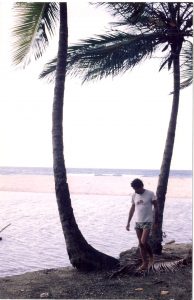
were pulled onto the beach and parked between the very tall palm trees. I use to go
there often, Puerto Maya was one of my favorite places, inhabited exclusively by black people,
poor but always willing to help or offer you at least a coffee. The fishermen always gave me
some fish for lunch and I helped them unload the fish from the boats. We camped on the beach
under the palm trees. With some bricks we built a stove to make a fire for cooking and tied the
hammocks to the palm trees.

Tabata and me
Kao would sleep in a hammock and Mary, Tabata and I in a tent.
Not only had Kao never seen the sea but he had never seen a black man and the blacks of
Puerto Maya had never seen an Indian from the Amazon. The meeting was one of the most
interesting. Kao understood immediately that there was not much difference between him and
those people, they too lived under the palm trees, they too went around barefoot and with
machetes, they too lit fires to cook and their children also ran free and naked in the street. The
blacks of Puerto Maya also had the same considerations, centuries-old victims of white
paternalistic racism, they were much freer from the prejudices that flourished in the cities.
Kao took off his shoes, took off his shirt and pants and remained in a loincloth like in the jungle.
He went to wash himself in the sea and was surprised by the salt water. Then he took Tabata’s
markers and began to draw his body with serpentines of all colors. Very precise drawings,
snakes and dots on his legs, face, back. Finally he put the parrot feathers back on his ears.
Kao had returned to being Kao.
We went for a walk around the village. The locals were curious, a woman I knew from whom I
bought cornbread and coffee, came out of her house and came to meet us. “Who is he?” she
asked me and I explained the whole story and the woman was moved “Poor thing, he’s all
alone, how sorry I am…” and then she invited him to drink coffee with a banana cake.
What a difference from the German lady of the photo lab in Caracas!

Fisherman of Puerto Maya
That evening there was a procession of people who came to see Kao. The conversations
around the fire were very funny, timidly at the beginning and with great laughter at the end.
They didn’t understand each other but they touched each other’s hair. They asked him what
the drawings he had made on his body were and he said something in Yanomami and they
immediately translated into Spanish making up “Snakes! He said they are snakes!” A chicken
passed by and everyone shouted “Chicken… Chicken” and Kao translated into Yanomami
“Kakkara, Kakkara”… and everyone laughed “Kakkara… aahah it’s called Kakkara…” They
sent a boy to look for a cat, in the meantime one had poured himself a glass of water, “Agua
agua” he said pointing to the glass and Kao replied: “Mau…Mau”. Then the cat arrived and
everyone started “And this one? Isn’t it a MauMau?” ahah everyone laughed. From that
evening Kao became a famous guest and everyone in the village was kind to him, some offered
him one thing and some another, even girls his age approached him and started chatting and
flirting. The fishermen didn’t always go out fishing but on the morning of the 31st they returned
with full boats and there was an abundance of fish for everyone and this was a good thing
because it was New Year’s Eve, Noche Buena, and they prepared Sancochos de pescado, fish
soups and corn cakes. Not much else because the town was poor and not much was found in
the shops but they did what they could and they accumulated beer, agua ardente and rum to
get through the night. Above all they prepared liters of orange juice with Aguardiente, a highly
alcoholic liquor, and cinnamon that they called Canelazo. A dangerous drink because it went
down like agua fresca, cool water, and not like aguardiente. The women had cooked all day,
making corn cakes, tortillas, arepas, biscochos, fish soup and chicken soup. Coffee was also
an important element and was made by pouring boiling water into a cloth cone filled with
coffee. They called it Cafe’ Guaioio.At sunset, a large fire was lit on the beach and Tio Ugo, a fisherman in his forties, was given the
task of heating the skin of the drums so that it would be stretched to the right point for the right
tone. These were three large drums, each with a different tone, which were placed in front of
the fire, at a certain distance, and Tio Ugo would caress and turn them according to the heat.
Some men brought the Tambor to the beach, a hollow tree trunk from which the bark had been
removed and in which holes had been dug that produced different sounds. The Tambor could
be played by more than one person, as long as they knew how to coordinate when hitting the
trunk.
Judging by the smoothness of the wood, that Tambor must have been used by generations of
drummers for popular celebrations and the Tambor ritual is the closest thing there is to the
ancestral African music imported by slaves. A rhythm played on the coasts of Venezuela, in
Colombia and on the coasts of all of Central America. In the Caribbean islands, from Cuba to
Trinidad and on the coasts of Brazil. It is the magical Tambor to whose sound magic and
voodoo rituals are performed, the sound from which Cuban Salsa, Dominican Merengue,
Colombian Cumbia and Brazilian Samba come and I could also say the Blues and Rock and
Roll. The beach was getting crowded, some came empty-handed, some with food and most
with bottles of Canelazo and beer. When the alcohol level reached the right level, the Tambor
and the three drums, which they called Tumbas, began to be played. The first blow was given
by Gambao, a fisherman with a crooked leg from birth, but still very agile, and the rhythm
immediately started wild and in no time everyone was dancing. Circles of people formed and in
the center the dancers took turns. The Tambor is a dance with a very high sexual reference,
often explicit. In the circle one couple dances at a time, maybe two, and anyone can push a
male or female dancer out and enter in his place. The exchanges are very fast like the rhythm
and do not last more than a few beats. You dance moving from the waist down, while the torso
must remain still. If you don’t know how to do it, they immediately throw you out of the circle.
Every now and then someone stopped to take a sip of Canelazo or Rum, but they immediately
started moving again. Mary, Tabatita, Kao and I also danced, but the only one who knew how
to do it was Mary. When there was a break, everyone drank, the musicians changed, some
went away and some came back. Then the music started again and everyone started dancing
again. This went on for several hours. Some lay down on the beach, others went swimming,
some ate and some sang… all to the rhythm of the Tambor. At a certain point Mary decided to
take Tabata to sleep saying she would be back later. In reality she also fell asleep in the tent
and that night I never saw her again. Kao and I continued dancing until someone started
shouting that it was almost midnight and everyone started to get excited and naturally grabbed
the bottles. In the light of the fire I saw Kao drinking Canelazo with a girl while she caressed the
drawings on his chest. A group of people passed by and someone put a bottle of Canelazo in
my hand, I took two sips and lost sight of Kao.
At midnight Las Mañanitas was organized, a kind of procession that goes from house to house
singing New Year’s greetings. Originally Las Mañanitas would be a religious tradition but in
Puerto Maya it was a pagan ritual of singing, eating and drinking. At each house we stopped to
sing accompanied by an out of tune guitar and a tambourine. The lady of the house offered
food and drink… and so on from house to house.
At one of these stops I ate one of the best fish soups of my life. The lady of the house invited
us to go to the back patio where a fire had been prepared on which the soup was boiling.
More Canelazo was offered. The procession continued.
Passing between one house and another I glimpsed Kao being led by the hand by the girl from
the beach disappearing into the darkness. Finally we arrived at the big Mango tree and that
was the end of the town but someone started saying that we had to go and sing Las Mañanitas
to Emma who lived on the hill and we set off in the dark stumbling over rocks and roots like
good drunks until we reached a little house from whose window the light of candles came out.
“Why didn’t she come to the beach?” I asked, “She’s a widow, her husband was killed in
Caracas a year ago and she lives alone. She’s still in mourning.”
“Poor old woman,” I thought. The guitar started to the rhythm of the tambourine and we
started to sing … “Que linda esta’ la mañana en que vengo a saludarte…Venimos todos congusto y placer a felicitarte…” At that point the door opened and Emma, not old at all, smilingly
sat down in the doorway. Someone offered her the bottle of Canelazo which she took and
drank “with much gusto”. Then she began to sing with a beautiful low and tuneful voice.
She was a beautiful woman, maybe thirty, maybe forty, with the blacks you couldn’t tell, often
they were younger or older than you thought. Las Mañanitas lasted half an hour during which
Emma offered corn and banana cookies. Little by little people began to say goodbye, each
staggering down the path to go back to the village .

Emma
Emma asked me if I wanted to try her mango liqueur, made with mangoes from the big tree. As
soon as I entered she took off her shirt and stood bare-chested: “No one has touched me for a
year” she said. Emma had smooth skin the color of milk chocolate, she smelled of mangoes
and aguardiente. Her curly hair was cut short and exposed her neck that I caressed while we
played at making love. I woke up at dawn with the crowing of roosters and parrots, a white
light came in through the window and Emma was sleeping naked next to me, she was beautiful
in the light of dawn just as she was beautiful in the candlelight. I thought about Mary, she must
have been furious with me… I got up, dressed in silence, took one last look at Emma sleeping
and left. The village was deserted, under the mango tree there were a few people sleeping,
empty bottles everywhere. Suddenly I thought about Kao and how stupid I had been to leave
him alone hoping that nothing had happened to him. Silently I approached our tent, one of the
hammocks was occupied, a good sign that meant Kao was sleeping. I approached and in the
hammock I saw that he was not alone. The girl from the beach was with him and was sleeping
peacefully topless in Kao’s arms who, awake, looked at me smiling with an expression of idiotic
happiness. Instead of parrot feathers on his ears he had flowers and on his chest, between one
snake and another, the girl from the beach had drawn two hearts. I settled into the other
hammock trying to recap the events but I fell asleep immediately. Tabatita woke me up to offer
me coffee. Her mother had slept all night with her and hadn’t noticed that I wasn’t there and
thought I had slept in a hammock, she just asked me: “What is this smell of mango on your
skin?” We stayed another few days in Puerto Maya, I didn’t see Emma again, even though I
would have liked to. I would see her again in the future during other visits. Kao’s girlfriend was
very sweet and stayed with us during those days and when it was time to leave tears came out
of her eyes. Kao was sad too and would have liked to stay. With love he had forgotten that he
was a Yanomamo from the Amazon jungle and was ready to become a fisherman of the
Caribbean Sea. The girl kissed him, held him tightly and then let go. The following days inCaracas
Kao was no longer interested in going out with me, he had understood that the
civilized world was not worth it, he thought of the sea, of the fishermen, of the freedom that
was missing in the city. He thought of the girl from the beach and there was nothing I could do
for him. Finally, as unexpectedly as he had arrived, Jaques Lizot returned to Caracas and
knocked on my door. When I opened it I found two gentlemen dressed in jackets and ties and
coats on their arms, it was January and they were coming from Paris, while in Caracas it was
always summer. Lizot had shaved and had put on a little weight, good French cuisine, even the
Yanomamo, whose name I have forgotten, had changed. Dressed completely in Western style,
gray suit, shiny black patent leather shoes, bright tie, without the stingers stuck in his face or
feathers in his ears. If it had not been for the fringe hairstyle I would not have recognized him.
The only sign of, let’s call it Indianness, were the strips of candy of all colors in transparent
paper that he was very fond of and that he wore around his neck like necklaces. Every now and
then he would break one off and eat it. At a certain point he sat down, crossed his legs, took
out a pack of cigarettes and lit one. I watched in disbelief at that transformation. If Kao had
become a Caribbean fisherman, this one had become a snob Parisian with candy around his
neck. Lizot saw my face and said to me: “They immediately absorb the worst of our society, he
has become addicted to cigarettes and candy.” Ultimately Kao had been lucky not to go to
Paris. Then the Parisian Yanomamo took off his jacket and shirt, and I saw that on his chest,
like Kao, he had drawn snakes. From his pouch he took out the wooden needles and stuck
them back in his face again with the parrot feathers in his ears.
He took off his patent leather shoes and went barefoot to smoke in the hammock. He offered
Kao a cigarette and they started chatting and laughing. They were laughing out loud, one said
something and they laughed, then the other said something else and they started laughing.
“What are they laughing at?” I asked Lizot, “They laugh at us, they say we are crazy.”
Mary lives and works in Caracas now, she is an artist. She founded and directed an art school
for children. She also works in theater.
Tabata is married and lives in London with her husband and a dog.
Jacques Lizot left the Amazon in the late 80s. In France he worked on ancient Arabic texts. He
passed away in 2022 at the age of 84.
I know nothing about Emma.
New York 2021/2025